
The Lean Learning Academy
Helping organizations develop teams that learn to improve their work.
Many organizations work very hard every day, yet the same operational problems continue to return.
Employees often see opportunities for improvement, but there is rarely a clear structure for studying the work and solving problems together.
The Lean Learning Academy was created to help organizations develop the internal capability to improve their operations over time.
Developing Leaders and Frontline Teams Through Real Operational Improvement
This program draws on leadership development practices originally learned at Toyota’s NUMMI plant and refined through 35+ years of operational coaching.
Most organizations begin with one small pilot team before expanding the approach across the business.
Who This Program Is Designed For
The Lean Learning Academy is designed for organizations where operations depend on teams working together every day, for example, production plants, food manufacturers, commercial bakeries, and hospitality operations.
Many of these organizations reach a point where leaders recognize that improvement cannot depend on a few managers or outside consultants. It requires teams who know how to observe their work, identify problems, and improve processes together.
The Lean Learning Academy helps organizations develop those capabilities by working with real teams inside the organization, using their own operational challenges as the learning environment.
How the Program Works
Participants from the same operation join the program and work in small improvement teams.
A typical group may include:
• frontline employees
• team leaders
• a manager sponsor
Teams apply what they learn directly to real operational challenges inside their organization.
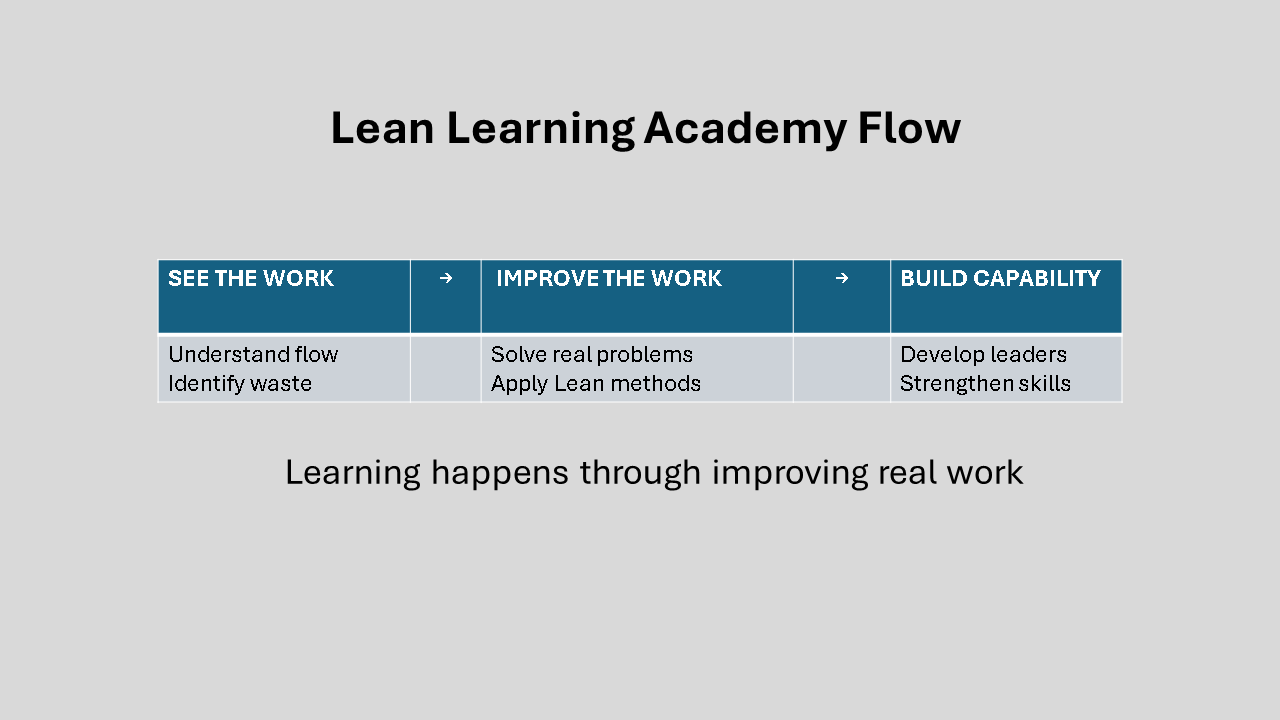
The goal is not simply to teach improvement tools, but to help organizations develop teams that know how to improve their work together.
The Learning Journey
Participants move through four stages of development.
Phase 1 — Foundations
Teams learn how to observe work, understand processes,
and identify improvement opportunities.
Phase 2 — Structured Continuous Improvement
Teams begin testing small improvements using a simple improvement
cycle often called PDCA (Plan–Do–Check–Adjust). This method helps
teams test
ideas, observe results, and refine their improvements step by step.
Phase 3 — Team Problem Solving
Teams solve meaningful operational challenges and present their results.
Phase 4 - Advanced Learning Opportunities
Teams help spread the learning throughout the organization
What Participants Often Experience During the Program
Organizations often notice important changes as teams begin working through the program.
At first, many participants are cautious. Some team members are not used to speaking openly about problems in their work. It may take a few sessions before people begin to share their observations and ideas.
As teams start working together on real operational issues, confidence begins to grow.
Participants often report that they begin to see their work differently. Instead of simply completing tasks, they start noticing opportunities to improve processes, reduce frustration, and make their work easier.
Team leaders frequently develop stronger facilitation and coaching skills as they guide discussions and support the improvement efforts of their teams.
Managers often observe something unexpected — employees who were previously quiet or disengaged begin contributing ideas and taking pride in the improvements they help create.
Over time, improvement becomes less of an event and more of a natural part of daily work.
Teams begin solving problems together, leaders learn how to support that process, and the organization gradually develops its own capability to improve.
Learning Structure
The Academy was originally developed during the pandemic when onsite consulting became impossible, and many organizations discovered that live online learning combined with real workplace improvement could be both practical and highly effective.
The Lean Learning Academy combines live weekly learning sessions with real operational improvement work inside the participating organization.
Participants join a weekly live online learning session where key improvement concepts are introduced and discussed.
Between sessions, teams apply what they learn directly to their own operations.
Organizations enrolling a full team cohort also receive dedicated online coaching sessions to support their team leaders and managers as improvement work progresses.
This guided improvement program method of training actually solves two big problems:
• travel costs
• taking people away from operations for training
The Outcome
Over time something important begins to happen.
Teams gain confidence in their ability to study the work and improve it.
Leaders begin thinking differently about how improvement happens.
The organization gradually becomes:
A Company That Knows How to Improve
This means:
• fewer recurring operational problems
• more engaged employees
• stronger team leadership
• more consistent operations
A Story About What Can Happen When People Are Given the Opportunity to Grow
Early in my career, while working in the training department at NUMMI (the joint venture between Toyota and General Motors), I saw something that shaped the way I think about developing people.
One employee in particular stood out. His name was Terry.
Terry had a reputation for being disengaged. Many people had quietly written him off as- someone who simply came to work, did his job, and left at the end of the day.
When the company began organizing employees into small improvement teams, Terry was placed in one of those teams.
Something unexpected happened.
As the team began observing their work and discussing problems together, Terry slowly began to open up. He started sharing ideas. His teammates began listening. Over time, their respect for him grew.
Eventually Terry was asked to step into the role of team leader.
By the end of the year, Terry’s team was recognized as one of the outstanding improvement teams in the plant.
And Terry stood in front of more than one hundred Toyota and NUMMI executives to present the team’s work.
Watching that transformation reinforced something I have believed ever since:
When people are given the opportunity to think, contribute, and improve their work, they often grow far beyond what anyone expected — including themselves.
That belief continues to shape the way the Lean Learning Academy works with teams today
Program Investment
The Lean Learning Academy is a 24-week team development program designed to build long-term improvement capability within operational teams.
Full Team Cohort (10 Participants)
$18,000 to develop a team over six months
Includes:
• Weekly live learning sessions
• Dedicated team coaching
• Leadership support for team leaders and managers
• Structured improvement work using the organization’s
own operational challenges
Smaller Groups
Organizations with smaller teams may participate at:
$1,800 per participant
(Smaller groups participate in the shared learning sessions but do not include dedicated team coaching.)
Is Your Organization Ready for This Type of Program?
The Lean Learning Academy works best in organizations where leaders are interested in developing their teams and improving how work is performed over time.
Organizations that benefit most from the program often share several characteristics:
• Leadership is open to learning alongside their teams
• Managers are willing to support improvement efforts inside their departments
• Employees are encouraged to observe problems and suggest improvements
• The organization is interested in developing its own long-term improvement capability
Organizations do not need to have previous experience with Lean methods to participate.
What matters most is a willingness to learn, experiment, and improve together.
Exploring Whether the Academy Is a Good Fit
Many organizations begin with a short conversation to explore whether the Lean Learning Academy is the right starting point for their teams.
During this discussion we typically talk about:
• the type of operation you run
• the improvement opportunities your teams are facing
• the number of people who may participate
• how the Academy could support your organization’s goals
Organizations are welcome to schedule a short introductory conversation before enrolling.
In many cases, organizations begin with one team and expand once they see how the learning process works inside their operation.
These conversations are valuable even if the organization decides not to participate immediately.